The battle of Verdun
Am 07. Mai 2026 machte sich die Jahrgangsstufe 9 des Gymnasiums Konz auf den Weg nach Verdun. Die lange Reise dorthin ist lohnenswert. In Verdun fand 1916 eine der größten Schlachten des Ersten Weltkriegs statt, die die Zerstörungswut und Sinnlosigkeit des Ersten Weltkriegs verdeutlicht. Deshalb ist Verdun heute ein wichtiger Ort der Erinnerung und steht für eine Verständigung zwischen Deutschland und Frankreich.
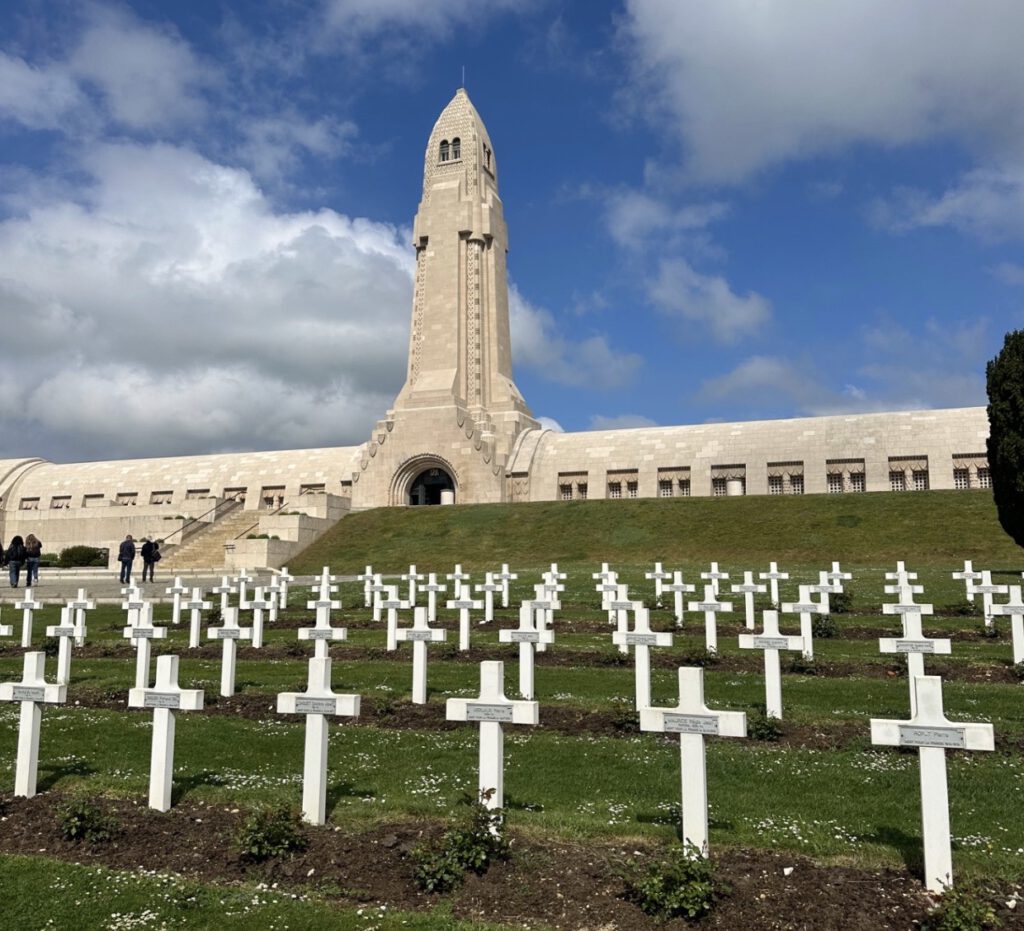
Im Rahmen dessen besuchten die Schülerinnen und Schüler zunächst das Beinhaus von Douaumont, in dem die Gebeine von 130 000 nicht identifizierbaren Soldaten aufbewahrt werden.
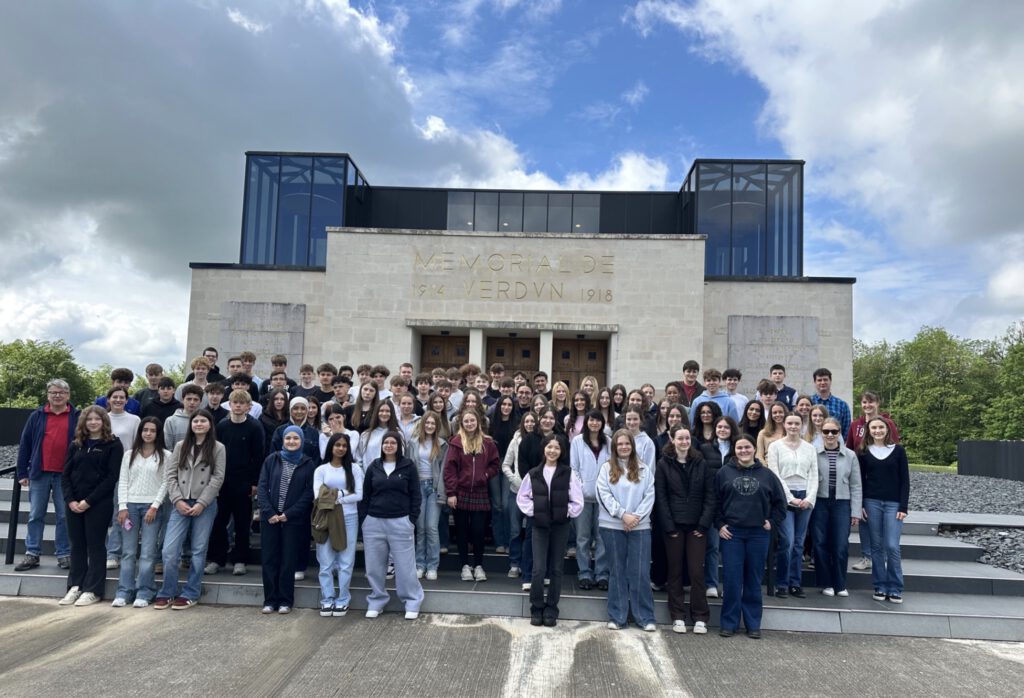
Dann begaben sich die Schülerinnen und Schüler gruppenweise in das moderne und interaktive Mémorial, wo zahlreiche Artefakte der Schlacht ausgestellt sind. Ein weiterer Programmpunkt war der Besuch der Anhöhe von Vauquois, die von deutscher und französischer Seite mit Stollen untergraben ist, die wir mit einer spannenden Führung besichtigen konnten. Die Eintrittsgelder und Führungen wurden freundlicherweise vom Förderverein übernommen und das ermöglichte den Schülerinnen und Schülern eine sehr lehrreiche und spannende Exkursion.
K. Horn
The Battle Of Verdun
Battle of Verdun fought between February and December of 1916 remains one of the most harrowing symbols of human endurance and suffering in history. Waged between France and Germany during World War One, Verdun was not merely a military campaign, but it rather became a brutal test of national will, where men were consumed by artillery fire, mud, exhaustion and fear. By the end of the battle over 700.000 soldiers had been reported missing, wounded or dead, Yet despite the unfathomable destruction which Verdun endured it stood as a symbol of French resistance and sacrifice.
The German offensive, led by General Erich von Falkenhayn, was supposed to “bleed France white.” Rather than capturing territory quickly, the strategy aimed at pressuring the French Army into a battle of attrition so devastating that France would collapse under the weight of its own losses. Verdun was chosen due to its symbolic importance. It was a historic fortress city on the Meuse River deeply tied to French pride and defense. Von Falkenhayn believed the French would never abandon it and he was correct.
When the bombardment began on February 21 1916, the earth itself seemed to break apart. Millions of shells rained upon the forts, forests and trenches surrounding Verdun. Villages vanished beneath smoke and debris, trees were stripped into blackened skeletons, men buried alive clawed through mud mixed with blood and shattered stone. The battlefield became a vision of hell, a place where survival often depended less on courage than on sheer chance.
French forces, commanded by General Philippe Rétain, organized relentless resistance. Supplies aswell as reinforcements traveled constantly along the “Voîe Sacrée”, the Sacred Way, a single road that became the lifeline of the French army. Soldiers marched towards the front knowing that many besides them wouldn’t ever return.
Diaries and letters speak not of glory at Verdun but of terror alone. Some men fought for days without sleep, surrounded by the cries of the wounded and the endless thunder of artillery. Some even described the battlefield as a graveyard without silence.
The forts of Douaumont and Vaux became legendary sights of resistance. At Fort Vaux, French Major Sylvain Raynal and his exhausted garrison defended the position under (almost) impossible conditions, suffering from thirst, suffocation while constantly getting bombarded. Their determination reflected the wider spirit of Verdun itself, endurance beyond human limits. Though the Germans captured several positions during the campaign, the French army ultimately held Verdun and by December 1916 much of the lost ground had been reclaimed.
However the victory at Verdun carried a terrible cost…, entire generations of young men disappeared in the trenches. Families received letters stained with mud or no letters at all. Survivors returned home scarred, not only in body but in spirit. Verdun revealed the horrifying reality of modern warfare. Machines had transformed battle into slaughter on a scale the world had never seen before. Courage still existed but it was buried beneath barbed wire, craters and endless rows of crosses.
Even today Verdun remains sacred ground in French history. Ossuaries hold the bones of thousands of unidentified soldiers, French and Germans alike, resting together in death after meeting in hatred and fear, while having bled the same red. The fields where armies once clashed are quiet now, yet beneath the soil lie fragments of weapons, helmets, even human remains, reminders that history doesn’t disappear simply because the guns fall silent.
What makes Verdun especially tragic in my opinion is not only the number of lives lost but how little humanity seemed to matter in the calculations of war. Young men who dreamed of ordinary futures were sent into the fire for only meters of scorched earth. Nations back then spoke of honor and victory while countless soldiers drowned in mud far from home.
When we visited Verdun on 7th May, 2026, I expected history, not the silence to feel so heavy. Our first step was the Douaumont Ossuary. The fields looked peaceful, yet everywhere I looked there were endless rows of white crosses stretching across the field like frozen waves of grief. Each cross marked a life cut short…, a son, a father, a brother, a friend, had who once laughed, dreamed and believed he would return home. Inside the Ossuary rest the bones of thousands of unidentified soldiers, French and German, together at last, no longer enemies, but victims of the same terrible battle. Looking through the small windows, where piles of bones and skulls could be seen, which unsettled me deeply. It felt as though the war had not ended, only fallen quiet.
During a hike across the hills and old trenches surrounding Verdun, exhaustion settled into my legs, I remember stopping to take a breath, while the cold wind moved through the trees which had regrown over the years after battle. In that moment I couldn’t stop my thoughts from drifting again- to the soldiers who had to endure these same hills not for hours, but for weeks and months under shellfire, hunger, rain and terror. The difference was that now all of us had warm clothes, water, food and, most importantly, the comfort of knowing that we’d return home safely…a comfort the soldiers didn’t have.
Our guide Mr.L Pierre then took us to the tunnels. We wore helmets and had torches as we navigated through the narrow underground forts where soldiers once waited in darkness, surrounded by damp stone, stale air and the constant fear of bombardment above them.
At the Mémorial we learned about even more gruesome details. We saw rusty weapons, torn equipment, battered helmets and letters to loved ones back home behind glass displays, but they didn’t feel like museum pieces, they felt painfully human. Each object carried the weight of the hands that once held it. Even now a shiver runs down my spine thinking of it, because Verdun isn’t only a place where history happened, it’s a place where humanity bled
Hanna Kíra Rétfalvi